

Embrace the Everyday Art of Soft Living for Trauma Survivors
Disclaimer
This article is written with care and grounded in research, but it is not intended to replace professional mental health support, therapy, counselling, crisis care, or medical advice. If you are struggling, please reach out to a qualified professional who can walk alongside you in your healing. You deserve that support.
Softness Is NOT Weakness
There is a particular kind of exhale that happens when you finally sit down at the end of a long day — when you wrap your hands around a warm mug, feel the steam rise toward your face, and allow your shoulders to soften. For a moment, the world grows quieter. The body, which has been bracing and carrying and holding on, remembers that it is allowed to rest.
This is the heart of soft living: a lifestyle devoted to comfort, calm, and conscious choices that transform ordinary moments into gentle luxuries. It is the art of creating a life that feels intentional rather than frantic, beautiful rather than merely busy. Soft living prioritises peace, wellness, and stillness. It romanticises the everyday — the first cup of tea, the afternoon light through a window, the slow ritual of tending to a small corner of the world that is yours.
For many, soft living is an aesthetic. But for trauma survivors, it can become something far more profound: a nervous system practice.
Trauma often leaves the body in a state of chronic vigilance. The nervous system, shaped by experiences of threat and overwhelm, learns to stay alert, to scan for danger, to brace against what might come next. Even when the external danger has passed, the body may continue to live as though it hasn’t (van der Kolk, 2014). This can look like exhaustion that sleep doesn’t fix, a startle response that fires too easily, or a persistent sense of being on edge even in safe surroundings.
Soft living, practised with intention, becomes an invitation for the nervous system to remember something it may have forgotten: that safety is possible. That rest is allowed. That gentleness is not a luxury earned through suffering, but a birthright worth reclaiming.
If you are a loved one reading this to understand better someone you care for, I hope this offers a window into why soft living might matter so deeply to them — why creating calm, protecting peace, and moving slowly are not indulgences, but acts of healing.
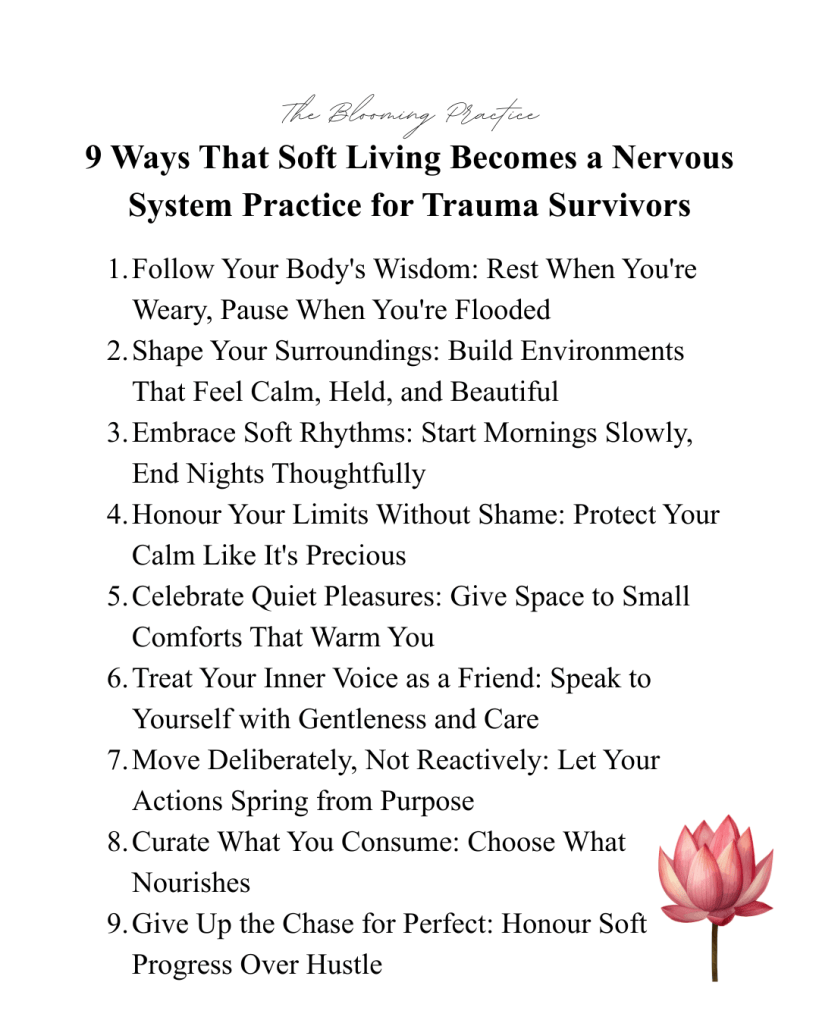
1. Follow Your Body’s Wisdom: Rest When You’re Weary, Pause When You’re Flooded
One of trauma’s quieter legacies is a disconnection from the body’s own signals. When survival once depended on pushing through — on ignoring pain, fatigue, or fear — the nervous system learns to override its own messages. Rest becomes suspect. Tiredness becomes something to conquer rather than heed.
Soft living invites a different relationship with energy. It asks: What if you listened? What if, when your body whispered that it was tired, you believed it? What if, when overwhelm began to rise like water in your chest, you allowed yourself to pause?
This is not laziness. This is the slow, patient work of rebuilding interoceptive awareness — the capacity to sense and respond to internal body states (Price & Hooven, 2018). For trauma survivors, this awareness may have been dulled or distorted as a protective measure. Reclaiming it is an act of coming home to yourself.
Think of it like a garden in winter. The soil is not failing when it rests; it is regenerating. Fallow seasons are not emptiness — they are preparation. Your body, too, knows how to restore itself, if you will let it.

2. Shape Your Surroundings: Build Environments That Feel Calm, Held, and Beautiful
The nervous system is constantly reading the environment for cues of safety or threat — a process Stephen Porges (2011) calls neuroception. This happens beneath conscious awareness, but its effects are felt in the body: the shoulders that tighten in a cluttered room, the breath that deepens in a space filled with soft light and familiar comfort.
For trauma survivors, environment matters profoundly. The places we inhabit send signals to our nervous systems, telling them whether to relax or remain on guard.
Soft living encourages the intentional curation of space. This might mean decluttering a corner of your home, adding textures that feel soothing to touch, placing a plant on a windowsill, or lighting a candle at dusk. It might mean surrounding yourself with objects that hold meaning — a photograph, a stone from a beloved place, a blanket that has wrapped you through difficult nights.
These are not frivolous choices. They are anchors. A windowsill lined with herbs, a worn wooden table where you drink your morning tea, a favourite chair that holds your shape — these things tell your nervous system, The danger is over. You are home now.
3. Embrace Soft Rhythms: Start Mornings Slowly, End Nights Thoughtfully
Trauma often brings chaos — not only in the events themselves, but in their aftermath. The internal world becomes unpredictable: moods shift without warning, sleep fractures, the body moves between hyperarousal and collapse. When life has felt uncontrollable, the nervous system may remain braced for the next disruption.
Gentle routines offer a different kind of message. They provide rhythm, predictability, and structure — not the rigid kind that demands perfection, but the soft kind that says, Here is something you can trust (Perry & Winfrey, 2021).
A morning ritual might be as simple as waking slowly, feeling your feet on the floor, drinking something warm before the world asks anything of you. An evening wind-down might include dimming the lights, putting away screens, and allowing the body to transition gently toward rest. These are not productivity hacks. They are gifts of safety.
Like the rising and setting of the sun, our bodies crave rhythms they can rely on. When we offer ourselves predictable gentleness, the nervous system begins to trust that not everything will be a surprise.

4. Honour Your Limits Without Shame: Protect Your Calm Like It’s Precious
For many trauma survivors, the word “no” does not come easily. If safety once depended on compliance, on reading others’ needs and meeting them before your own, the nervous system may have learned that refusal is dangerous. This is sometimes called the fawn response — a survival strategy rooted in appeasing others to avoid conflict or harm (Walker, 2013).
Soft living reframes boundaries not as walls that shut people out, but as fences around a garden. A fence does not mean you are unkind; it means you are tending to what grows within. It keeps what nourishes close and what depletes at a distance.
Learning to say “no” is a practice in self-trust. It is a way of telling your nervous system, I will protect you now. You do not have to abandon yourself to stay safe.
Guilt may arise when you set a boundary — that is normal, especially if boundaries were once met with punishment or rejection. But the presence of guilt does not mean the boundary was wrong. It means you are learning a new language, and new languages take time to feel natural.
5. Celebrate Quiet Pleasures: Give Space to Small Comforts That Warm You
Pleasure can be a complicated territory for trauma survivors. If pleasure was once unsafe, forbidden, or used as a tool of manipulation, the body may have learned to distrust enjoyment. Joy becomes something to earn, to justify, to feel guilty about.
Soft living gently challenges this. It says: You are allowed to enjoy things. You are allowed to feel good in your body, in your home, in your life.
Small, daily luxuries — a favourite tea, a soft robe, fresh flowers on the table, a candle lit at dusk — are not frivolous. They are invitations for the nervous system to soften. Positive sensory experiences can activate the ventral vagal pathway, the branch of the nervous system associated with calm, safety, and social connection (Dana, 2018).
Think of the ritual of afternoon tea: the warmth of the cup, the fragrance rising, the permission to pause. These moments are not escapes from life. They are life — the tender, ordinary, beautiful kind that trauma may have taught you to overlook.

6. Treat Your Inner Voice as a Friend: Speak to Yourself with Gentleness and Care
Trauma often installs a harsh inner critic. This voice may echo the words of those who hurt you, or it may have developed as a way to pre-empt criticism from others. It tells you that you are too much, not enough, broken, unworthy. It speaks in the language of shame (Herman, 2015).
The way we speak to ourselves matters. Internal dialogue is not just words — it is a signal to the nervous system. Harsh self-talk activates threat responses; gentle self-talk can soothe them.
Self-compassion research shows that treating ourselves with kindness — especially in moments of suffering — can reduce anxiety, depression, and trauma-related distress (Neff & Germer, 2018). This does not mean ignoring mistakes or avoiding accountability. It means speaking to yourself as you would to a dear friend, or to a child who is struggling.
If you are a garden, your self-talk is the weather. You cannot control every storm that comes, but you can learn to offer yourself more sunlight. You can choose, moment by moment, to speak words that help things grow.
7. Move Deliberately, Not Reactively: Let Your Actions Spring from Purpose
Trauma can create patterns of over-functioning — a constant doing, fixing, managing, controlling. This may have been necessary once, when vigilance kept you safe. But when the nervous system stays locked in survival mode, even ordinary tasks can feel urgent, driven by an invisible pressure that says you must keep moving or something terrible will happen.
Soft living invites a different pace. It asks you to notice the difference between “I have to” and “I choose to.” It encourages action that comes from clarity rather than compulsion.
This supports something essential that trauma often disrupts: a sense of autonomy. Judith Herman (2015) writes that the restoration of power and control is central to trauma recovery. When you move through your day with intention — pausing before responding, choosing rather than reacting — you are practising that restoration.
There is a difference between rushing through a task and tending to it. Think of the slow, deliberate work of kneading bread: the rhythm, the patience, the way the hands know what to do. Soft living is about bringing that quality of attention to ordinary life.

8. Curate What You Consume: Choose What Nourishes
The nervous system does not always distinguish between real threats and perceived ones (van der Kolk, 2014). When we scroll through distressing news, expose ourselves to constant comparison on social media, or consume content that dysregulates us, the body responds as though the threat is present. Cortisol rises. The heart beats faster. The system remains on alert.
Soft living encourages intentional consumption. This is not about avoidance or burying your head in the sand. It is about discernment — recognising that what you take in affects how you feel, and choosing accordingly.
You might curate your social media feeds to include more beauty, gentleness, and inspiration. You might set boundaries around news consumption, checking in at chosen times rather than constantly. You might choose books, podcasts, and music that soothe rather than agitate.
We are careful about what we plant in a garden. We can be equally thoughtful about what we plant in our minds.
9. Give Up the Chase for Perfect: Honour Soft Progress Over Hustle
Perfectionism is often a trauma response in disguise. It is a way of trying to be safe — to be beyond criticism, beyond rejection, beyond the unpredictable responses of others. If you were perfect enough, perhaps you could control outcomes. Perhaps you could finally be acceptable. Perhaps no one would hurt you again.
But perfectionism is a trap. Research links it to anxiety, depression, and burnout (Hewitt & Flett, 2002). It keeps the nervous system in a state of chronic striving, never arriving, never enough.
Soft living offers a different path. It releases the grip of “enough.” It says: You do not have to earn rest. You do not have to earn joy. You do not have to earn peace.
Healing is not linear, and neither is soft living. There will be days when softness feels impossible, when old patterns return, when the inner critic speaks louder than the gentle voice you are learning to cultivate. That is okay. The practice is not about perfection. It is about returning, again and again, to gentleness.
Wildflowers do not grow in perfect rows, and neither does healing. There is beauty in the unruly bloom.

The Blooming Practice
Here are two small, gentle practices you might try — not as assignments, but as invitations. You can take what resonates and leave what doesn’t.
The Daily Softness Check-In
Once a day — perhaps in the morning, or during a quiet moment in the afternoon — pause and ask yourself: What does my body need right now? What would feel gentle?
You don’t have to act on the answer perfectly. Simply noticing is enough. Over time, this practice rebuilds the interoceptive awareness that trauma may have dimmed. It teaches your nervous system that you are listening, that you can be trusted to respond with care.
Create One Small Anchor of Beauty
Choose one small, sensory anchor of softness in your environment. It might be a candle you light each evening, a plant on your windowsill, a favourite mug you reach for each morning, or a photograph that brings you comfort.
Let this object become a cue for your nervous system — a signal that says, You are allowed to be here. You are allowed to rest. You are safe in this small corner of the world.
Conclusion
Soft living is not about perfection, productivity, or performance. It is not another standard to meet or another way to fail. For trauma survivors, it is something quieter and more profound: a reclamation. Of safety. Of pleasure. Of the right to exist gently in a world that has not always been gentle with you.
Some days, softness will feel within reach — a warm cup of tea, a moment of stillness, a boundary held with grace. Other days, it will feel impossibly far away, and that is okay. Healing is not about arriving at some perfect destination. It is about tending — returning, again and again, to the practices that help you feel more at home in your own body, your own life.
If you are a loved one reading this, I hope you see now why soft living might matter so deeply to someone you care for. Their need for calm, for beauty, for protected peace is not fragility. It is wisdom. It is the nervous system learning, slowly, to trust that the world can be safe. Your patience, your gentleness, your quiet presence beside them matters more than you may know.
Like a garden after a long winter, something in you is learning to bloom. Not because you forced it. Not because you hustled or performed or earned it. But because, finally, you are giving yourself the conditions to grow.

Join The Blooming Tribe!
If this article resonated with you, I would be honoured if you would follow me on Instagram, Substack, TikTok, and LinkedIn, where I share more reflections on trauma, healing, and gentle living.
Leave a comment below — I love hearing from you. What is one thing you can do today to be more gentle towards yourself?
If you know someone who might need these words, please like and share this piece with them.
If you are looking for support on your healing journey, I offer counselling and would be glad to walk alongside you.
And if you haven’t already, subscribe to The Blooming Practice so these letters can find their way to your inbox.
Thank you for being here. Thank you for tending to yourself.
References
Dana, D. (2018). The Polyvagal Theory in Therapy: Engaging the rhythm of regulation. W. W. Norton & Company.
Herman, J. L. (2015). Trauma and recovery: The aftermath of violence — from domestic abuse to political terror (2nd ed.). Basic Books. (Original work published 1992)
Hewitt, P. L., & Flett, G. L. (2002). Perfectionism and stress processes in psychopathology. In G. L. Flett & P. L. Hewitt (Eds.), Perfectionism: Theory, research, and treatment (pp. 255–284). American Psychological Association. https://doi.org/10.1037/10458-011
Neff, K. D., & Germer, C. K. (2018). The mindful self-compassion workbook: A proven way to accept yourself, build inner strength, and thrive. Guilford Press.
Perry, B. D., & Winfrey, O. (2021). What happened to you? Conversations on trauma, resilience, and healing. Flatiron Books.
Porges, S. W. (2011). The Polyvagal Theory: Neurophysiological foundations of emotions, attachment, communication, and self-regulation. W. W. Norton & Company.
Price, C. J., & Hooven, C. (2018). Interoceptive awareness skills for emotion regulation: Theory and approach of Mindful Awareness in Body-Oriented Therapy (MABT). Frontiers in Psychology, 9, 798. https://doi.org/10.3389/fpsyg.2018.00798
van der Kolk, B. (2014). The body keeps the score: Brain, mind, and body in the healing of trauma. Viking.
Walker, P. (2013). Complex PTSD: From surviving to thriving. Azure Coyote Publishing.


Leave a Reply