
Philosophy
Bloom and Grow Forever…
At The Blooming Practice, I do not believe there is one correct way to heal, grow, or build a meaningful life.
Human beings are wonderfully complex. We are shaped by our experiences, relationships, environments, bodies, beliefs, strengths, losses, hopes, and the ways we have learned to survive.
That means meaningful support cannot simply be copied from a textbook and applied in exactly the same way to every person.
My philosophy begins somewhere much simpler:
Meet the person where they are. Understand before trying to change. And make space for growth to happen at their own pace.
The Philosophy in One Sentence
Understand yourself with compassion, honour the ways you learned to survive, grow at your own pace, and create a life that feels increasingly like your own.
A Person Before a Problem
My work is grounded primarily in the Person-Centred Approach developed by Carl Rogers.
At the heart of this approach is the belief that you are not a problem waiting for someone else to solve.
You are a person with a history, an inner world, strengths, needs, values, fears, hopes, contradictions, and the capacity to continue growing.
I do not position myself as the expert on your life.
You know your internal world in a way that nobody else ever fully can.
My role is to listen, ask thoughtful questions, offer perspective and psychoeducation, introduce useful tools and strategies, and create the kind of relationship in which greater understanding can emerge.
Rather than asking only: “What is wrong?”
I am also interested in:
- “What happened?”
- “What helped you survive?”
- “What do you need now?”
- “What matters to you?”
- “And where would you like to go from here?”
The curious paradox is that when I accept myself just as I am, then I can change.
Carl Rogers
The Relationship Matters
Rogers believed that meaningful growth is supported by three fundamental qualities within the helping relationship.
They remain central to the way I work.
Empathy
I want to understand your world as you experience it.
Empathy means listening beyond the surface of what happened and becoming curious about what an experience meant to you.
It does not require agreement.
It requires the willingness to listen without immediately judging, correcting, dismissing, or imposing another person’s interpretation upon your experience.
Acceptance
You should not have to become more acceptable before you deserve to be heard.
I aim to create a space where you can bring the complicated parts too: fear, anger, grief, shame, uncertainty, contradiction, coping strategies you may not understand, decisions you regret, and things you are still trying to make sense of.
Acceptance does not mean that every behaviour is helpful or that nothing needs to change.
It means we can explore what needs to change without making your worth dependent upon it.
Authenticity
Human connection requires realness.
I strive to show up as a genuine human being rather than hiding behind an impersonal professional façade.
That means being present, transparent where appropriate, honest about my limitations, and willing to acknowledge when I do not know something.
The counselling relationship remains professional, with clear ethical boundaries, but it can also be warm, collaborative, compassionate, and deeply human.

An Integrated Approach
People rarely fit neatly inside a single psychological theory.
Neither does life.
While my foundation is person-centred, my broader philosophy is integrative and holistic.
This means I draw thoughtfully from different psychological perspectives, counselling principles, psychoeducation, wellbeing practices, and practical tools according to the needs, goals, circumstances, and preferences of the person I am supporting.
These may include ideas informed by:
- person-centred and humanistic approaches;
- cognitive and behavioural principles;
- solution-focused approaches;
- narrative perspectives;
- mindfulness and present-moment awareness;
- systems and ecological perspectives;
- strengths-based approaches;
- emotional regulation and nervous-system awareness; and
- trauma-informed principles.
Rather than asking you to adapt yourself to a rigid method, I aim to adapt the work to you.
Because people are not templates.
Looking at the Whole Person
We do not exist separately from the lives we have lived.
Our emotional wellbeing can be influenced by our relationships, childhood experiences, families, communities, workplaces, cultures, responsibilities, physical wellbeing, financial circumstances, identities, losses, opportunities, and the wider systems in which we live.
For this reason, I try not to reduce human difficulties to something happening solely “inside” an individual.
Sometimes, what looks like a personal weakness makes much more sense when we understand the environment in which it developed.
Sometimes, a coping strategy that causes difficulty today once served an important purpose.
And sometimes growth does not begin by asking yourself to try harder.
It begins by understanding why you learned to live this way in the first place.

Trauma-Informed, Not Trauma-Defined
Trauma can profoundly affect how someone experiences themselves, other people, their body, relationships, emotions, safety, and the world around them.
But I do not believe a person’s trauma should become their entire identity.
A trauma-informed approach asks us to recognise that behaviours often have histories.
Hypervigilance may have developed because vigilance once mattered.
Avoidance may have offered protection.
People-pleasing may have helped preserve relationships.
Emotional numbness may have allowed someone to keep functioning when feeling everything would have been overwhelming.
Understanding these responses does not mean remaining trapped within them forever.
It gives us somewhere compassionate to begin.
We can honour what helped you survive while gently exploring what might help you live now.
Oubaitori: You Bloom in Your Own Time
There is a Japanese expression, Oubaitori (桜梅桃李), represented by four different flowering trees: cherry, plum, peach, and apricot.
Each blossoms differently. Each has its own shape, fragrance, beauty, and season. And none needs to become another tree in order to bloom well.
I love this idea because it captures something fundamental about growth: Your life does not need to unfold according to somebody else’s timetable.
Someone else reaching a milestone sooner does not mean you are behind. Someone healing differently does not mean you are doing it incorrectly. Someone else’s strengths do not make yours less valuable.
Growth is not a race towards becoming the same person.
It is an unfolding into more of who you are.
Your history is different. Your needs are different. Your season is different.
You bloom in the way only you can.
The Lotus: Why Blooming?
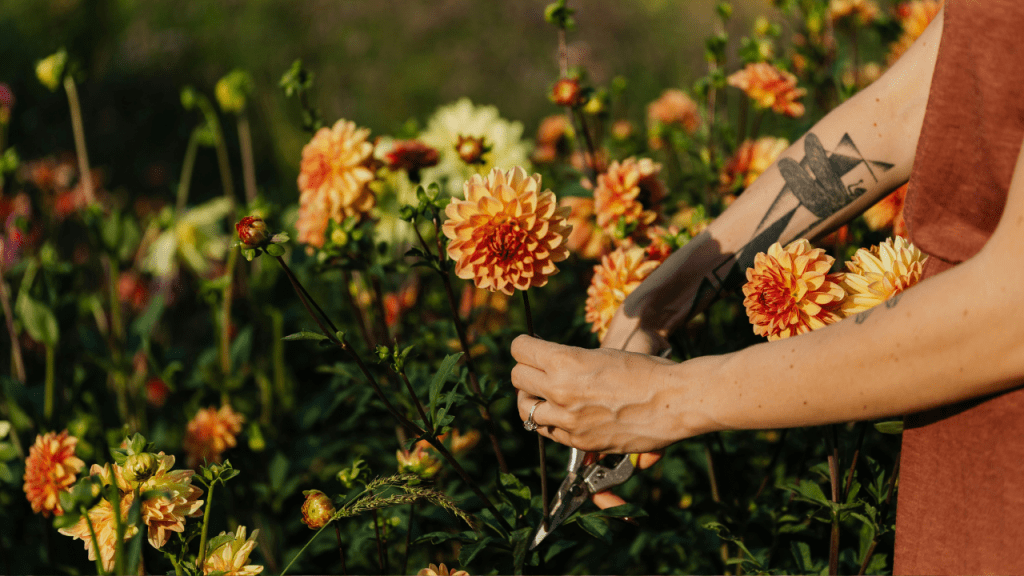
The lotus at the heart of The Blooming Practice is more than a logo.
It represents one of the central ideas behind my work.
The lotus begins rooted in mud.
It does not wait for pristine conditions before growing.
Its roots remain connected to the darkness beneath the water while the plant reaches towards the surface and eventually opens into the light.
There is something deeply human in that image.
Healing does not require pretending the mud never existed.
Growth does not erase the conditions from which we came.
And becoming stronger does not require being grateful for everything that hurt us.
Instead, the lotus reminds me that something beautiful can grow while remaining rooted in the truth of where it came from.
Our past belongs to our story.
It simply does not have to write every chapter that follows.
If you look the right way, you can see that the whole world is a garden.
Frances Hodgson Burnett

ThMy Assumptions About Healing and Growth
There are several beliefs that quietly underpin everything I do at The Blooming Practice.
I believe:
You are always more than the hardest thing that has happened to you.
People make sense in context. Thoughts, feelings, behaviours, and coping strategies often become more understandable when we explore the experiences surrounding them.
The past influences us without necessarily determining our future.
Self-understanding can create new choices. We have more room to respond differently when we begin noticing the patterns operating beneath the surface.
Coping strategies deserve curiosity before criticism. Many developed because they once helped us manage something difficult.
Growth is not linear. Progress can include pauses, setbacks, repetition, grief, uncertainty, and periods when very little seems to be changing.
Awareness often comes before change. We cannot consciously choose differently until we begin noticing what is happening.
People deserve agency. Support should strengthen your capacity to make informed choices rather than create dependence upon the person helping you.
Rest is part of growth. Human beings cannot sustainably live in a state of constant striving.
There is no universal timeline. Healing, learning, adjustment, and personal growth happen differently for different people.
Meaningful change can be small. Sometimes the beginning of a different life is a boundary, a breath, a conversation, a new understanding, or one different choice.
People are just as wonderful as sunsets if you let them be.
Carl R. Rogers
When I look at a sunset, I don’t find myself saying, “Soften the orange a bit on the right-hand corner.” I don’t try to control a sunset.
I watch with awe as it unfolds.
The Blooming Being
Living Gently. Growing Intentionally. Blooming Authentically.
The Blooming Being is not a perfected version of yourself waiting somewhere in the future.
It is not someone who is always calm, productive, positive, healed, confident, or certain.
A Blooming Being is simply someone learning how to participate more consciously in their own life.
They begin where they are. With what they have. In the season they are currently living through.
They become curious about their inner world. They notice what nourishes them and what drains them. They learn where they need boundaries and where they need connection. They begin recognising old patterns without shaming themselves for having them. They discover what matters to them.
They rest. They experiment. They make mistakes. They change direction. They grieve. They learn.
They begin again.
And gradually, they create a relationship with themselves that feels less like a battle and more like a place they can live.
A flower does not use words to announce its arrival to the world; it just blooms.
Matshona Dhliwayo
Growth Has Seasons
No garden blooms continuously.
There are seasons for flowering. Seasons for growing roots. Seasons for shedding what has finished. Seasons for rest.
And seasons when, from the surface, almost nothing appears to be happening at all.
Human growth is much the same.
There will be moments when change feels exhilarating and others when it feels painfully slow.
There may be old patterns you thought you had left behind. There may be grief alongside progress. There may be days when simply treating yourself with a little more kindness is the work.
None of this means you have stopped growing.
Some of the most important growth happens quietly, underground.
We don’t ask a flower any special reason for its existence.
Gwendolyn Brooks
We just look at it and are able to accept it as being something different for ourselves.

Your Space. Your Pace.
At The Blooming Practice, I want you to have room to explore your life without being forced towards somebody else’s definition of healing, success, happiness, or personal growth.
I can offer knowledge. Questions. Reflection. Perspective. Tools. Encouragement. Challenge when it is helpful. And a space in which you do not have to pretend.
But ultimately, the life being created is yours.
You decide what matters. You decide what you are ready for. You decide what blooming means.
My role is to walk beside you for part of the journey.
Your space. Your pace. Your way of blooming.
A world of grief and pain
Kobayashi Issa
flowers bloom—
even then.
Interested in Receiving Counselling?
Send an email to thebloomingpractice@gmail.com or a WhatsApp message to +27 71 342 9810 to make an appointment with me or ask any questions.
I will respond in between seeing clients during the following South African business hours (GMT +2):
- Monday to Friday: 08h30 – 19h00
- Saturday and Sunday: Closed
In case of an emergency, go to your nearest police station or to the emergency room of your nearest hospital.
Excited to hear from you!