
Philosophy
Bloom and Grow Forever…
Rather than subscribing to a single school of thought, I believe in an integrated approach, drawing on various perspectives and modalities, depending on my clients’ needs and experiences. That being said, I lean towards the humanistic school of thought, specifically the Person-Centred Approach proposed by Carl Rogers, which maintains that clients are a product of their own subjective experiences.
I also borrow and integrate elements, principles, and concepts from various other theories and modalities to create a holistic view of my clients and underpin my interventions. This includes, but is not limited to the Ecological Systems Theory, Cognitive Behavioural Therapy (CBT), Solution-Focused Brief Therapy (SFBT), Systems Theory, Narrative Therapy, Psychodynamic Therapy, Gestalt Therapy, Existential Therapy, and Mindfulness Therapy.
- ECOLOGICAL SYSTEMS THEORY: Bronfenbrenner posited that an individual’s development is influenced by a series of interconnected environmental systems, ranging from the immediate surroundings (e.g., family) to broader societal structures (e.g., culture). He divided the environment into five systems: microsystem, mesosystem, exosystem, macrosystem, and chronosystem.
- COGNITIVE BEHAVIOURAL THERAPY (CBT): CBT is a type of psychotherapy that helps individuals identify and change unhelpful thought patterns and behaviours to improve their mental and emotional well-being. It focuses on the present and aims to develop practical strategies for managing current problems. According to CBT, thoughts, feelings, and behaviours are interconnected.
- SOLUTION-FOCUSED BRIEF THERAPY (SFBT): SFBT is a short-term, goal-oriented therapeutic approach that focuses on helping clients identify and build upon their strengths and resources to achieve desired outcomes, rather than dwelling on problems.
- SYSTEMS THEORY: Systems Theory is concerned with the web of connections between persons and world, self and others. Systemic Therapy addresses problems that arise not within the individual as such, but rather within their broader life: their family and friends, work, and within the social (cultural, political, economic) context.
- NARRATIVE THERAPY: Narrative Therapy is a form of psychotherapy that focuses on helping individuals reframe their life stories, separating themselves from their problems and identifying alternative, empowering narratives. It views clients as experts in their own lives, encouraging them to challenge limiting beliefs and create more positive and meaningful narratives.
- PSYCHODYNAMIC THERAPY: Psychodynamic Therapy, originating with Sigmund Freud, emphasises the role of unconscious psychological processes and early childhood experiences in shaping personality and behaviour. It explores how these unconscious forces, often stemming from unresolved conflicts, influence current thoughts, feelings, and behaviors.
- GESTALT THERAPY: Gestalt Therapy is a form of psychotherapy that focuses on a person’s present experience and encourages self-awareness and acceptance, using techniques like role-playing and the empty chair technique to facilitate personal growth.
- EXISTENTIAL THERAPY: Existential Therapy is a form of psychotherapy rooted in existential philosophy, focusing on the human condition, free will, self-determination, and the search for meaning, rather than solely addressing symptoms.
- MINDFULNESS THERAPY: Mindfulness Therapy is a type of talk therapy that focuses on cultivating awareness of thoughts, feelings, emotions, surroundings, and situations, aiming to reduce automatic responses and improve overall well-being and daily functioning.
Other perspectives that inform my beliefs on healing, learning, and growth are Oubaitori and the symbolism of the lotus flower. Additionally, several assumptions underlie my approach to counselling and life coaching.
The curious paradox is that when I accept myself just as I am, then I can change.
Carl Rogers

Oubaitori
The Japanese have an idiom “Oubaitori” (桜梅桃李) that signifies each flower blooms in its own time, meaning we all grow and flourish at our own pace.
“Do not compare yourself to others; like the cherry, plum, peach, and apricot trees, each blooms in its own time.”
Each individual character is representative of a different kind of blossom. However similar these blossoms may appear, they all bloom differently with their own unique smells and shapes. Despite or perhaps because of these differences, each and every blossom blooms proudly and distinctly in its own way. Individuals grow, learn, adjust, and heal just as differently as these blossoms bloom. Everyone is special and should be proud of their differences. Therefore, we should concentrate on our own growth and value what makes us unique rather than comparing ourselves to others.
Each tree has its unique character, timing, fragrance, and beauty. None tries to become the other; none blooms early or late “wrongly.” This becomes a metaphor for human life. This concept teaches you to appreciate your unique path and timing, to stop comparing your growth to others. It’s about honouring your own gifts, pace, and process.
You bloom in the way only you can.
Symbolism of the Lotus Flower
In my business logo, I use the image of a lotus. Why?
The lotus flower is one of the most universal and powerful symbols across spiritual traditions. Its meaning is rich, layered, and timeless.
The lotus has a unique life cycle of life, death, and re-emergence compared to other plants. With its roots securely grounded in mud, the lotus immerses itself every night into river water and then blooms once more the next morning – brilliantly clean. The lotus seeks protection in the mud, but because of the waxy protection layer on its flower petals, its beauty remains unchanged when it blooms once more the next morning.
While the meaning of the lotus flower differs from culture to culture, it generally depicts purity, strength and rebirth. Lotus flowers are a symbol of purity because they rise from mud without being stained. And yet, they return to murky water every evening – only to bloom again at the break of day. This symbolises resilience, rebirth, and strength. Additionally, the lotus flower means transcendence because of man’s spirit transcending worldly matters when it blooms from the underworld into the light.
If you look the right way, you can see that the whole world is a garden.
Frances Hodgson Burnett

The Person-Centred Approach by Carl Rogers
Also known as Non-Directive, Client-Centred, or Rogerian Therapy, the Person-Centred Approach was created by Carl Rogers during the early 1940s. This psychotherapeutic model of intervention emphasises the client’s experience of themselves instead of positioning the counsellor as the expert who informs the client of what is wrong with them and instructs the client what to do. It contends that individuals are intrinsically motivated to realise positive psychological functioning. Human beings are driven towards self-actualisation, which is the force behind change.
Thus, the client is regarded as the expert in their own life and knows themselves best, instead of being inherently flawed with problematic behaviours that need treatment from a counsellor who is in a position of authority over the client. Each person is perceived as having the capacity for growth, adjustment, healing, and learning. Therefore, the client determines the direction the counselling follows. This approach is strength-based, with the client treated as a person first. The focus is primarily on the client, their capabilities, and how they can help themselves, rather than their mental health condition, with external help prioritised secondarily.
Consequently, the counsellor employs a non-directive instead of a mechanistic approach. The counsellor aims to create and hold a space that promotes uncensored self-exploration to achieve clarity in their perception of themselves that is conducive to growth. Rogers believed that negative perceptions of the self hinder the client from achieving self-actualisation. Consequently, the counsellor’s role is to enhance the client’s understanding of themselves through reflection and clarifying questioning without making judgments.
Intervention is tailored to the client’s unique needs, experiences, and circumstances, honouring their age, gender, sexual orientation, culture, spirituality, and language. Ergo, the Person-Centred Approach is flexible.
The Core Conditions of the Person-Centred Approach
Rogers offered three attitudes necessary from the counsellor which underlie the Person-Centred Approach. This determines the quality of the counselling relationship, forming the basis thereof as a “way of being”. These core conditions are:
- Unconditional positive regard
- Congruence
- Empathy
Unconditional Positive Regard
Unconditional positive regards consists of the counsellor’s genuine and deep caring for their clients. It involves the counsellor’s attitude of acceptance and approval of the client’s being, regardless of the client’s choices, behaviour, shortcomings, or mistakes. This lets the client open up and discuss their challenges more freely with the counsellor without fearing criticism or judgement.
Congruence
Congruence is about being real, genuine, open, integrated, and authentic during interactions with others. Therefore, the counsellor does not put on a façade or lie but instead transparently expresses their thoughts and feelings to authentically relate to the client. Being congruent means experiencing an alignment between an individual’s internal experiences, feelings, and thoughts and their external expression or behaviour. Thus, the counsellor’s internal and external experiences are one and the same. For me, congruence exists on a continuum rather than an all-or-nothing basis.
Empathy
Being empathic is about the counsellor putting themselves in the client’s shoes to feel what that client might feel in a situation. Empathy means the ability to recognise emotions in others and to understand their perspectives on a situation – whether the counsellor agrees with these or not. It is characterised by an awareness of other people’s emotional experiences and an attempt to feel those same emotions from their perspective. Empathy involves taking the time to listen and experience the world as the client experiences it without judgment. It is the counsellor’s ability to understand sensitively and accurately (but not sympathetically) their client’s experiences and feelings in the present. Ultimately, it implies sensing the client’s feelings as if they were the counsellor’s own without becoming lost in those feelings.
People are just as wonderful as sunsets if you let them be.
Carl R. Rogers
When I look at a sunset, I don’t find myself saying, “Soften the orange a bit on the right-hand corner.” I don’t try to control a sunset.
I watch with awe as it unfolds.

Assumptions Underlying The Blooming Practice
- Counselling and life coaching are about choices – giving people new choices and resources to use.
- The past does not have to dictate the future.
- There is no such thing as failure – only feedback. There are no mistakes – only results. Without what we conventionally regard as “failure” and “mistakes”, learning would be impossible.
- The response that you get is your responsibility. If you are not getting the response you want, it’s your responsibility to change your approach until you do.
- People are not broken. They work perfectly well. They do not need to be fixed.
- People have all the resources and skills to make any change they want.
- People make the best decisions given the resources that they have.
- All external behaviour is the result of internal processes.
- Our perception of reality is not reality. It is, however, very real to us.
- Flexibility is key: the person with the most behavioural flexibility will adapt successfully to any situation.
A flower does not use words to announce its arrival to the world; it just blooms.
Matshona Dhliwayo
The Blooming Being
Living gently, growing steadily, blooming where you are planted.
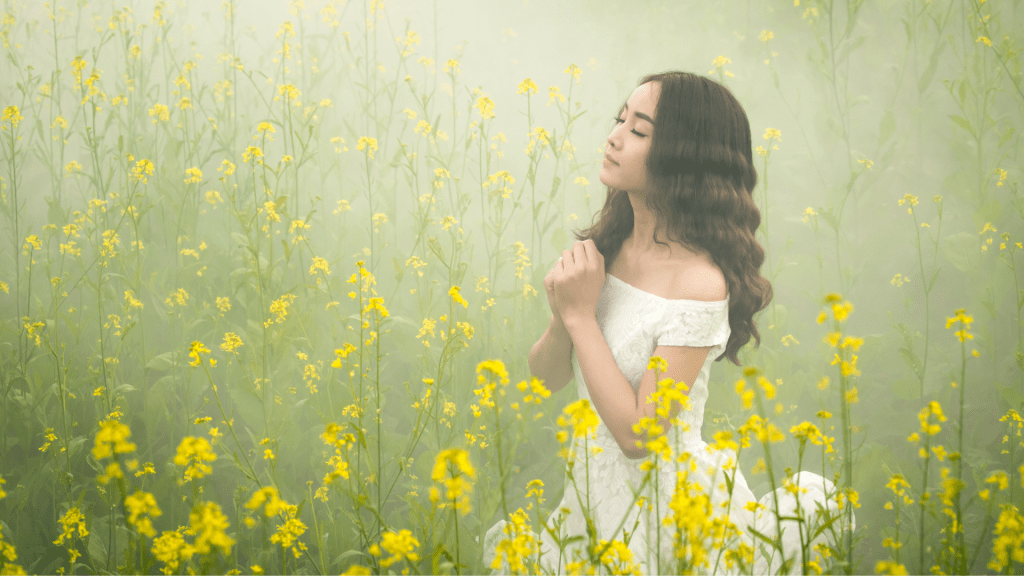
The Blooming Being is someone who begins right where they stand — in the soft soil of their ordinary life. They look to what they already have: their talents, stories, quirks, strengths, longings, and the quiet blessings scattered through their days like wildflowers. They understand that growth doesn’t wait for perfect conditions. Just as a seed roots into the soil it finds, the Blooming Being begins with what is available, letting life unfold naturally from there.
Their journey starts with awareness — a slowing down, a deep breath, a moment of listening to their inner world the way one might pause to hear the wind moving through tall grass. They explore their thoughts and emotions with curiosity, turning inward as one might wander through a familiar garden path: noticing what is thriving, what needs pruning, what longs for light, and what is still tender. With warmth and patience, they grow, make mistakes, rest, recalibrate, and gradually fall in love with themselves and the life they are shaping.
To be a Blooming Being is to honour your own rhythm, just as every flower blooms in its own season and every fruit ripens in its own time. No two gardens look the same, and no two lives unfold in the same pattern. The Blooming Being accepts this with a soft heart. Like the rose who embraces its thorns, they cherish their imperfections as part of what makes them rare and real. Their missteps become compost — nourishing the soil of future wisdom.
Becoming a Blooming Being is an unfolding dance with life: slow, organic, and ever-changing. Some days feel like warm sun and open meadows; others feel like misty mornings where the next step is hidden. Still, they keep moving gently. They let their intuition guide them like a lantern on a quiet forest path.
Uncertainty, discomfort, fear, and risk are recognised not as enemies but as natural weather patterns in the landscape of growth. Through storms and seasons, the Blooming Being discovers their resilience — the same resilience found in dandelions pushing through stone or vines climbing steadily toward the light. They begin to trust that they can survive, adapt, and even flourish in unexpected places.
And slowly, tenderly, life begins to bloom beyond what they once imagined. The dreams they plant in faith begin to sprout. Opportunities appear like wild berries along the roadside. Joy lingers like sunlight on cottage windows. What grows is not only what they hoped for, but often something richer, more rooted, and more beautifully aligned.
As your guide, I long to support you in becoming a Blooming Being, so that you may learn how to offer yourself the gentle acts of care that nourish your heart, soothe your nervous system, and support your unfolding. The Blooming Practice invites you to experience how simple, intentional shifts — like tending a small daily ritual, cultivating stillness, or reconnecting with your breath — can transform your inner landscape.
And you carry this practice with you, the way one keeps a pressed flower between the pages of a beloved book: as a reminder, a touchstone, a soft place to return to whenever the world feels heavy.
Still, this journey honours your space, your pace — like a garden tended with patience and trust. I move with you, step by step. I go where you go.
We don’t ask a flower any special reason for its existence.
Gwendolyn Brooks
We just look at it and are able to accept it as being something different for ourselves.

The Blooming Practice
I started the Blooming Practice to share my knowledge, experience, and the inspiration that have sprouted from my own beautiful journey, so that I can empower you to create your dream life and embrace your full potential – to create a Blooming Life and become a Blooming Being.
I believe that at our best, human beings are meant to love their lives and make a positive impact with the gifts they’ve been blessed with. My wish is that we would all dare to be brave, take a chance by believing in ourselves, and set out to build the lives we truly want. At the Blooming Practice, I focus on holistically supporting the individual. In order to be completely healthy, we must consider the mind, body, and soul equally.
Use my services, resources, and products to discover more about yourself, what you want out of life, and how to overcome your fears so that you can become empowered to be your favourite self and live your best life. With my rich experience and easy-to-use tools, you can reprogramme your mind for self-acceptance, self-love, self-worth, self-care, gratitude, and positive thinking to achieve optimum happiness and, more importantly, lasting peace.
You have the power to create a beautiful and meaningful life. Blooming is an art. Make it your masterpiece.
A world of grief and pain
Kobayashi Issa
flowers bloom—
even then.
Interested in Receiving Counselling?
Send an email to thebloomingpractice@gmail.com or a WhatsApp message to +27 71 342 9810 to make an appointment with me or ask any questions.
I will respond in between seeing clients during the following South African business hours (GMT +2):
- Monday: 08h30 – 19h00 (excluding 10h30 to 13h00)
- Tuesday: 08h30 – 19h00 (excluding 10h30 to 13h00)
- Wednesday: 08h30 – 19h00 (excluding 10h30 to 13h00)
- Thursday: 08h30 – 19h00 (excluding 10h30 to 13h00)
- Friday: Closed
- Saturday: Closed
- Sunday: 09h00 – 13h30
In case of an emergency, go to your nearest police station or to the emergency room of your nearest hospital.
Excited to hear from you!



 The Blooming Practice