
Frequently Asked Questions
Deciding to seek counselling is a really great choice to make, but, understandably, you might be uncertain about some things – especially if you’ve never gone for counselling before.
On this page, I answer some of the common questions that potential clients often ask me before they start counselling…
Minds are like flowers.
Stephen Richards
They open only when the time is right.

Frequently Asked Questions About Specialist Wellness Counselling
WHAT IS COUNSELLING?
Counselling is a service whereby individuals or couples seek support, education, and intervention for a variety of mental health and emotional challenges from a counsellor. Counselling usually tends to deal with crises as they arise in the present moment, but can also address longer-term difficulties. Sometimes counselling involves exploring past relationships and experiences to make sense of them, but other times it means reflecting on the here and now.
Counselling can provide you with the time, space, and insight to deal with any challenges, issues, problems, or concerns you may be facing. By collaborating with an impartial, professional, experienced counsellor, you will have the chance to express and discuss things that you are not ready or comfortable talking about with a friend, family member, or colleague.
Counselling does not come in a one-size-fits-all format and sessions are usually tailored to the needs, disposition, and circumstances of the individual.
To find out more, check out my What Is Counselling? blog post!
WHAT IS THE DIFFERENCE BETWEEN COUNSELLING AND THERAPY?
It is common for the terms “counselling” and “therapy” to often be used interchangeably.
Psychotherapy is a broad term used to describe talking therapies – this includes counselling. Both counsellors and psychotherapists offer support and intervention for a variety of mental health and emotional challenges. The difference lies in the approach they take, their education and training, as well as their scope of practice.
Counselling is a type of talking therapy that involves a trained counsellor listening to a client and offering support to the client in finding ways to deal with emotional issues and adjustment crises. While “counselling” and “therapy” are frequently used to mean the same thing, counsellors typically work with specific challenges over a shorter period of time, whereas therapists usually go deeper, attempting to deal with the root causes of issues and treatment taking place over a longer period of time. Counsellors tend to address issues at the time of crisis, while therapists deal with longer-term psychological problems.
If I believe you need additional help that falls outside of my competence or scope of practice as your specialist wellness counsellor, I will refer you to the right mental health professional.
WHAT IS A SPECIALIST WELLNESS COUNSELLOR?
The specialist wellness counsellor is competent to lend comprehensive and specialised counselling support towards the improvement of the quality of life by assisting client’s in resolving conflicts, improving relationships, sorting out general problems, coping with life’s challenges, and finding inner peace. The primary aim is not to treat, but to improve, not to diagnose, but to screen (identify), and not to cure, but rather to care. Specialist wellness counsellors make use of various techniques and tools to accomplish this. This requires skills with certain basic outcomes.
The specialist wellness counsellor serves to enhance the total wellbeing of their clients by making use of a systems approach to counselling – working towards achieving wholeness within the integrative unity of body, mind and spirit. The level of counselling is that of primary health care.
Specialist wellness counsellors specialise in one or more of the following areas of counselling/coaching: individual counselling, marriage counselling, lifestyle coaching, counselling for problems, trauma counselling, drug and alcohol abuse counselling, HIV/AIDS counselling, counselling for addictive behaviours, research in the domain of counselling, addiction, loss and bereavement counselling, hospice counselling and support and assistance in human development.
The generic scope of a life skills practice is that of wellness which includes, but is not limited to, providing support in interpersonal social relationships, spiritual growth, marital relationships, parental relationships, health related issues such as stress management, lifestyle management in prevention of chronic diseases, victim empowerment, domestic violence, trauma debriefing, household planning, HIV/AIDS, counselling, workplace adaptation, risk taking, study methods, management of anxiety and depression, substance abuse, support of vulnerable people, meeting cultural issues and diversity in the workplace, improvement of employment prospects, support to people with disabilities, mental preparation for retirement, and any other general problem that people encounter in day to day living.
The counsellor is bound to a specific scope of practice which is comprehensive but excludes psychotherapy, social work, medical health work and occupational therapy. Specialist Wellness Counsellors are not allowed to diagnose and are therefore required to refer clients to medical and psychological professionals if they identify needs that require specialised intervention such as mood, personality and anxiety disorders, and health related problems that require medical attention.
For more information, take a look at the What Is a Specialist Wellness Counsellor? blog post.
WHERE DO SPECIALIST WELLNESS COUNSELLORS FIT IN AMONG MENTAL HEALTH PROFESSIONALS?
There are various terms used to describe mental health professionals with each of them helping clients in their own unique way. There are many different mental health professionals who support and assist with a wide range of mental health concerns. The main types of mental health professionals are psychiatrists, psychologists, and counsellors.
Understanding the key differences between these professionals and how they can offer support will help you choose which one is the best fit for you if and when you decide to seek help.
Ultimately, however, each of these mental health professionals refer clients to one another depending on the client’s needs. For example, a counsellor may refer a client to see a psychiatrist if they believe the client requires medical intervention.
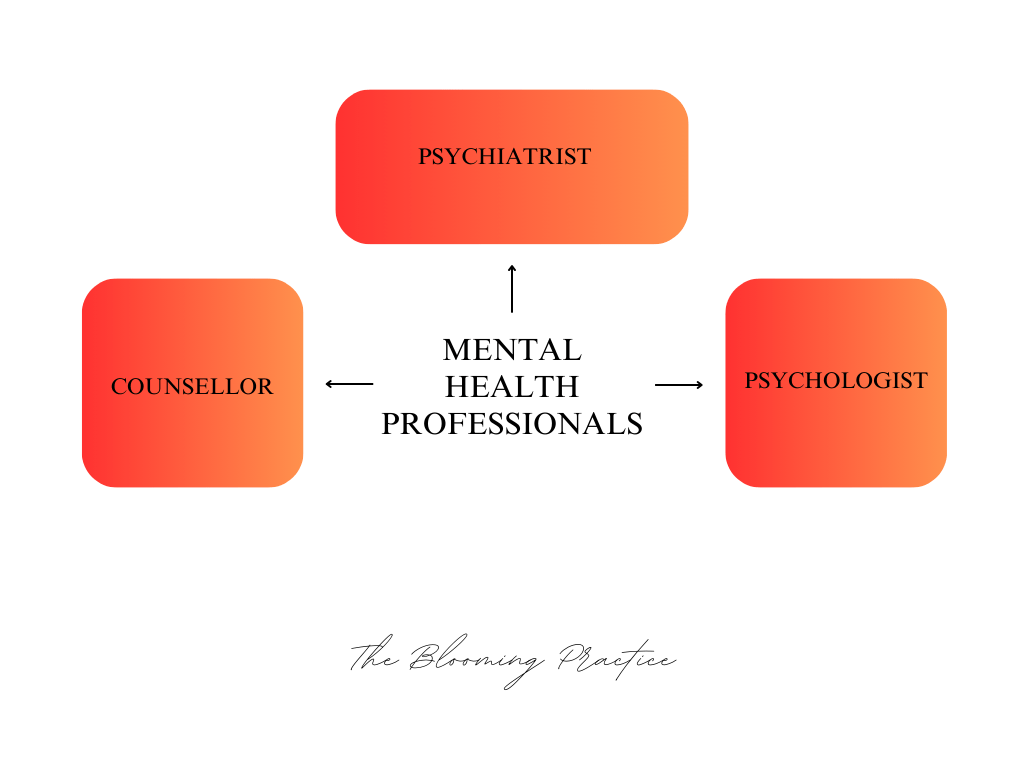
Psychiatrist
Psychiatry means the study of mental illness and involves diagnosis, management, and prevention. To become a psychiatrist, one needs to receive full medical training and qualify as a doctor, before being allowed to specialise in the field of psychiatry. Once fully qualified as a psychiatrist, they are allowed to specialise even further in general psychiatry, child/adolescent psychiatry, elder psychiatry, psychotherapy, or forensic psychiatry. Psychiatrists are the only mental health professionals who have the necessary training to assist in medical treatment and testing.
Psychologist
Psychology involves the study of the human mind and the way human beings think and behave. Psychologists are concerned with both mental health conditions and the way human minds work in everyday life. Psychologists are either research-oriented (focusing on better understanding how the human mind works) or applied (they apply their knowledge and skills to helping clients).
Counsellor
A counsellor utilises psychotherapeutic models of intervention to facilitate clients in understanding and gaining insight into their thoughts, feelings, and behaviour, as well as overcoming adjustment crises. The counsellor’s purpose is to help their clients implement strategies and tools that will resolve specific challenges or a current issue. For example, loss and grief. Frequently, the problems a counsellor addresses are externally triggered and include the client’s goals. A counsellor intends to provide the client with tools and solutions in the short term that are effective in the long run. Sometimes simply talking through one’s difficulties with a counsellor is sufficient, while in other cases a more structured, individually tailored approach is needed – depending on the nature of the challenge(s) as assessed by the counsellor.
In South Africa, registered counsellors register with and are regulated by the Health Professions Council of South Africa (HPCSA) and work in the field of psychology. However, specialist wellness counsellors register with and are regulated by the Association for Supportive Counsellors and Holistic Practitioners (ASCHP) and work in the field of wellness.
Thus, specialist wellness counsellors work in holistic settings on primary health care level. They aim to enhance the wellbeing of the client with reference to personal growth and development, acquiring of coping skills, personal, social and work fulfilment, and finding meaning and purpose for peaceful existence and living “the good life.” Specialist wellness counsellors can refer to psychotherapists, psychologists, or social workers should it be required. In order to qualify as a specialist wellness counsellor, postgraduate training and experience is necessary.
DO I NEED COUNSELLING?
It is your choice as to whether you want to try counselling or not.
However, counselling is recommended if you struggle to cope with the demands of everyday life and find it hard to function at home, school and/or work. Going through lifestyle changes can be a demanding process that requires time, effort, and support to adjust to.
Speaking confidentially to an impartial counsellor who is not personally invested in your life can have a positive impact on your psychological functioning. Counselling provides a regular, consistent opportunity for you to explore your feelings and discuss any issues you’re experiencing. A specialist wellness counsellor supports you in finding healthier, more helpful and effective coping mechanisms that allow you to deal with your problems, move forward, and improve your quality of life.
For more information, read through my Do I Need Counselling? blog post!
WHAT ARE THE BENEFITS OF COUNSELLING?
Counselling can be advantageous for anyone who wants to identify disturbing thoughts, process uncomfortable feelings, and resolve an issue or problem they are experiencing. Individuals may choose to consult a counsellor because they do not feel ready or at ease discussing personal/professional challenges with partners, friends, family, or colleagues, or they may want to talk to an unbiased party with an impartial point of view. Often times, clients simply want a safe and confidential space they can express and be themselves in.
Counselling can support you in better understanding yourself and the way you think, which leads to a greater awareness and clearer understanding of the challenges you face. The more you know about a problem, the easier it becomes for you to navigate the complexities thereof, thus enabling you to feel more empowered and positively about the situation you find yourself in.
Common topics, and concerns worked on in counselling are addiction and substance abuse, loss, grief and beareavement, bullying and abuse, illness, mental health, relationships, and trauma.
As a specialist wellness counsellor, I do not offer concrete advice or a to-do list of things that will make you feel better. Instead, I will provide you with the necessary tools and help you to explore and understand your problems so that you can gain clarity and insight to resolve these difficulties on your own.
To learn more, see my blog post on The Benefits of Counselling!
WHAT IS THE DIFFERENCE BETWEEN COUNSELLING AND THERAPY?
It is common for the terms “counselling” and “therapy” to often be used interchangeably.
Psychotherapy is a broad term used to describe talking therapies – this includes counselling. Both counsellors and psychotherapists offer support and intervention for a variety of mental health and emotional challenges. The difference lies in the approach they take, their education and training, as well as their scope of practice.
Counselling is a type of talking therapy that involves a trained counsellor listening to a client and offering support to the client in finding ways to deal with emotional issues and adjustment crises. While “counselling” and “therapy” are frequently used to mean the same thing, counsellors typically work with specific challenges over a shorter period of time, whereas therapists usually go deeper, attempting to deal with the root causes of issues and treatment taking place over a longer period of time. Counsellors tend to address issues at the time of crisis, while therapists deal with longer-term psychological problems.
Rest assured that if I believe you need additional help that falls outside of my competence or scope of practice as a specialist wellness counsellor, I will refer you to the right mental health professional.
DOES THE COUNSELLING TAKE PLACE ONLINE OR FACE-TO-FACE?
Counselling at The Blooming Practice takes place online.
All counselling sessions are conducted using Google Meet. When experiencing technical difficulties with Google Meet, Zoom is used instead. This enables me to share my screen with clients during the session. In an absolute emergency, WhatsApp video call is used.
During the video call, clients are required to have both their video and audio turned on. They also need to be in a comfortable position in a room where they have privacy and won’t be disturbed.
Online counselling allows me to work with clients regardless of their location and enables them to receive counselling in a safe, comfortable, familiar space.
NOTE: I do not offer text-, email-, or phone-based counselling. Clients are, however, welcome to email or WhatsApp message me in between sessions if they have any questions regarding the counselling process, my policies and payments, or if something particularly challenging or significant comes up.
The client agrees not to record counselling sessions. Sessions may not be audiotaped or videotaped.
INDIVIDUAL, COUPLES, OR GROUP COUNSELLING?
You may prefer to see a counsellor by yourself, or as a couple or in a group.
Going to couples counselling can be helpful if you want to save and nurture your relationship for the present and the future with tools and skills to draw on during difficult times.
Attending a group session can be beneficial if you wish to discuss your issues, connect with individuals experiencing similar challenges, and find a support network.
Receiving individual counselling is preferable if you want to focus on your own experiences and maintain your privacy.
To learn more about individual, couples, and group counselling, visit my Specialist Wellness Counselling page.
HOW LONG DOES EACH COUNSELLING SESSION LAST?
Each individual and couples counselling session lasts 50 minutes.
Group sessions may run longer, depending on the format of the meeting, the size of the group and the topic being discussed.
HOW OFTEN DO I NEED COUNSELLING?
This depends on several factors, such as the nature and severity of the adjustment crisis the client experiences, the client’s resilience, availability, and how often the client can afford counselling sessions. Sometimes, the intensity of the counselling process can also affect how often clients wish to seek counselling.
Typically, most clients opt for weekly sessions and then increase or decrease the frequency of their sessions as needed. However, fortnightly and monthly sessions are also possible. Then, of course, some clients feel they require multiple sessions in one week if they are in a state of crisis (usually at the beginning of the counselling process). Generally clients who have been in counselling for a while or who are not in deep distress come for counselling sessions as needed.
As a matter of professional ethics, I need to determine whether I think clients seeking counselling less frequently will be ineffective. Similar to clinical medicine where some antibiotics are effective only if you take them daily and correctly for a prescribed period, counselling is only effective if you receive the necessary frequency and amount of sessions. Some clients experience difficulties where attending counselling less often just won’t bring about the change they need. In these cases I may have to decline seeing a client less frequently because I would just be taking their fees without actually having faith in the effectiveness of the counselling.
HOW MANY COUNSELLING SESSIONS WILL I NEED?
There is no one-size-fits-all answer to this question. It depends on the severity of your problems and the status of your personal progress.
For some clients, a single session wherein they have the space to talk and someone to listen to them is all it takes. However, for the majority of cases, one session is not enough for clients to work through the problems they are facing. It all depends on the client themselves and their unique circumstances.
Counselling is a journey that requires time, effort, and consistency to be effective and sustainable. Therefore, I recommend several, regular sessions to get the most out of the counselling process.
As a rule of thumb, 12-16 counselling sessions are recommended. If you commit to weekly sessions, that adds up to 3-4 months of counselling. However, this is a very broad guideline and may not be applicable to every client.
HOW MUCH DOES SPECIALIST WELLNESS COUNSELLING COST?
For individual counselling with adult clients (ages 25 – 64), the first consultation/initial intake session is charged at R 600.00 for a 50-minute session, while subsequent 50-minute sessions cost R 500.00 per session.
For couples counselling with adult clients (ages 18+), the first consultation/initial intake session is charged at R 700.00 for a 50-minute session, while subsequent 50-minute sessions cost R 600.00 per session.
Group counselling for adult clients (ages 25-64) is charged at different rates, depending on the size of the group and the nature of the counselling offered. For example, workshops on psychoeducation, coping skills, trauma debriefing, etc.
| FOR ADULT CLIENTS (AGES 26 TO 64) | The First Consultation/Initial Intake Session of 50 Minutes | Subsequent 50-Minute Sessions |
| Individual Counselling | R 600.00 | R 500.00 |
| Couples Counselling | R 700.00 | R 600.00 |
| Group Counselling | Not Applicable | Depends on the Size of the Group and the Nature of the Counselling Offered |
Individual and group counselling to adolescents (13 to 17 years old), students (18 to 25 years old), and pensioners (65 years and older) are offered at a 20% discount per session.
The following rates and fees therefore apply:
| FOR ADOLESCENTS (13 TO 17 YEARS OLD), STUDENTS (18 TO 25 YEARS OLD), AND PENSIONERS (65 YEARS AND OLDER) | The First Consultation/Initial Intake Session of 50 Minutes | Subsequent 50-Minute Sessions |
| Individual Counselling | R 480.00 | R 400.00 |
| Couples Counselling | Not Applicable | Not Applicable |
| Group Counselling | Not Applicable | Depends on the Size of the Group and the Nature of the Counselling Offered, But a 20% Discount Will Be Offered to the Usual Fees and Rates |
To claim the special discount of 20%, proof of age is required.
To find out more about the financial terms and conditions, check out the Policies page.
Please note that Marelize reserves the right to offer discounts on fees and rates to clients at her discretion.
I’VE DECIDED TO SEEK COUNSELLING. WHAT DO I DO NOW?
Reach out to me via email at thebloomingpractice@gmail.com or send me a WhatsApp message at +27 71 342 9810. Let me know that you are interested in receiving counselling and want to make an appointment.
I will then respond by sending you a client intake form and informed consent and counselling services contract. You will have to read through these, fill them out, sign them, and then send them back to me BEFORE your first counselling session can take place.
I will also let you know my availability and suggest several dates and times for booking your first counselling session.
As soon as we’ve settled on a date and time, I will send you an email confirming the appointment and receipt of your intake form and contract.
I usually share the meeting link for Google Meet the day before the counselling session is scheduled to take place.
Business Hours
Time zone: GMT+2 (South Africa)
- Monday: 08h30 – 15h30
- Tuesday: 08h30 – 15h30
- Wednesday: 08h30 – 15h30
- Thursday: 08h30 – 15h30
- Friday: Closed
- Saturday: Closed
- Sunday: 09h00 – 13h30
WHAT CAN I EXPECT DURING MY FIRST COUNSELLING SESSION?
Don’t worry – it’s completely normal and natural to feel anxious about your first counselling session. Deciding to reach out and ask for help in addressing the challenges you are facing is an important first step towards learning, healing, and growth. Commend yourself for taking this first step! Here’s some information about that first apppointment that might make you feel more prepared and less nervous…
Before assessing your situation, I will begin the first counselling session by setting clear boundaries for the counselling process and relationship. This includes explaining and getting your verbal agreement and consent on the limitations of confidentiality. I will also answer any questions or concerns you may have about the counselling process and relationship.
NOTE: At this point, you will already have been required to fill out your intake form, as well as read through and sign the contract I sent you BEFORE the first session. The first counselling session CANNOT take place if you have not sent me back your filled-out and signed forms. Any questions or concerns you may have about these documents need to be addressed and resolved before you fill out, sign, and send them back to me.
Next, I will ask you questions to assess your current circumstances and gain a clear picture and general understanding of the challenges you face, how it affects you, what resources you have available to you, what solutions or coping mechanisms you’ve employed and whether they’ve been helpful or harmful to you. It is advised that you be honest and open when answering these questions to get the most out of your counselling sessions. All the information obtained will be used to help set initial goals for the counselling process and formulate an intervention.
Finally, we will determine your current level of self-care and emphasise the importance thereof during the counselling process.
WHAT DOES THE COUNSELLING PROCESS ENTAIL?
Healing a psychological wound is similar to healing from a physical wound. In fact, the word “trauma” comes from the Greek “trauma” (τραύμα) meaning “wound”. You start by stopping the bleeding and cleaning the wound, before going on to dress it. You then keep the wound clean as you regularly change the dressing, until, finally, a scar forms. Sometimes, the wound is infected and it requires a little more effort. Sometimes the wound is big and deep, requiring stitches. Regardless, healing is a process that doesn’t happen overnight and for which there are no quick fixes. Even then, evidence that the wound was once there may remain in the shape of a scar.
Counselling frequently entails recognising uncomfortable, upsetting emotions and discussing distressing, painful memories. Initially, this is difficult to do and you may be met with internal resistance that may even make you feel worse. Feeling your feelings and working through them is a necessary part of the process to help you move forward and to feel better in time. Because of this, psycho-education and coping strategies are essential.
Have your counselling sessions take place consistently and frequently to get the most out of the counselling process. Some sessions may feel more relevant and helpful than others. However, everything that I as your specialist wellness counsellor do is designed to help you in the long run and not just immediately, even if it doesn’t feel that way, especially in the beginning. I want lasting, long-term change for you.
Counselling is not a one-size-fits-all approach or quick fix. My job as your counsellor is not to tell you what to do but to create a space that empowers you to realise it for yourself. Thus, the counselling process needs a strong relationship between you, the client, and myself, the specialist wellness counsellor. Again, however, it takes time to build trust and rapport to the point where I can effectively and gently challenge you to achieve the necessary change needed for learning, growth, and healing.
It will also require no small degree of effort on your part. Prepare yourself for this. Counselling will take you places that you never thought you could go.
To find out more about the counselling process, read the What Is Counselling? blog post.
WHAT DO I DO IN CASE OF AN EMERGENCY?
In case of an emergency, go to your nearest police station or the emergency room of your nearest hospital.
WHAT FINANCIAL TERMS AND CONDITIONS APPLY?
Since specialist wellness counsellors are registered with the Association for Supportive Counsellors and Holistic Practitioners (ASCHP), and not with the Health Professions Council of South Africa (HPCSA), session fees cannot be billed to the client’s medical aid insurance.
The client agrees that they are ultimately responsible for paying the bill.
Payment for each session needs to made within 72 hours after the session is scheduled to take place. An invoice will be sent to the client after each session.
The client agrees that if they miss a session without cancelling, cancel with 24 (twenty-four) hours’ notice for non-emergency reasons, or are more than 15 minutes late to a session, they will still be charged the full fee. Clients understand that they are responsible for paying for missed sessions per this policy.
The Blooming Practice only accepts electronic funds transfer (EFT) payments.
Please email proof of payment to thebloomingpractice@gmail.com after making a payment.
The Blooming Practice will provide a client with a receipt for all fees paid.
DOES THE BLOOMING PRACTICE OFFER SEMINARS, WORKSHOPS, AND EVENTS?
Yes! Please direct all enquiries about seminars, workshops, and events to me via email at thebloomingpractice@gmail.com or send me a WhatsApp message at +27 71 342 9810.
Don’t let the tall weeds cast a shadow on the beautiful flowers in your garden.
Steve Maraboli

I Have More Questions…
Feel free to contact me if there is anything else you are unsure of or would like to know more about!
If we could see the miracle of a single flower clearly, our whole life would change.
Buddha


 The Blooming Practice